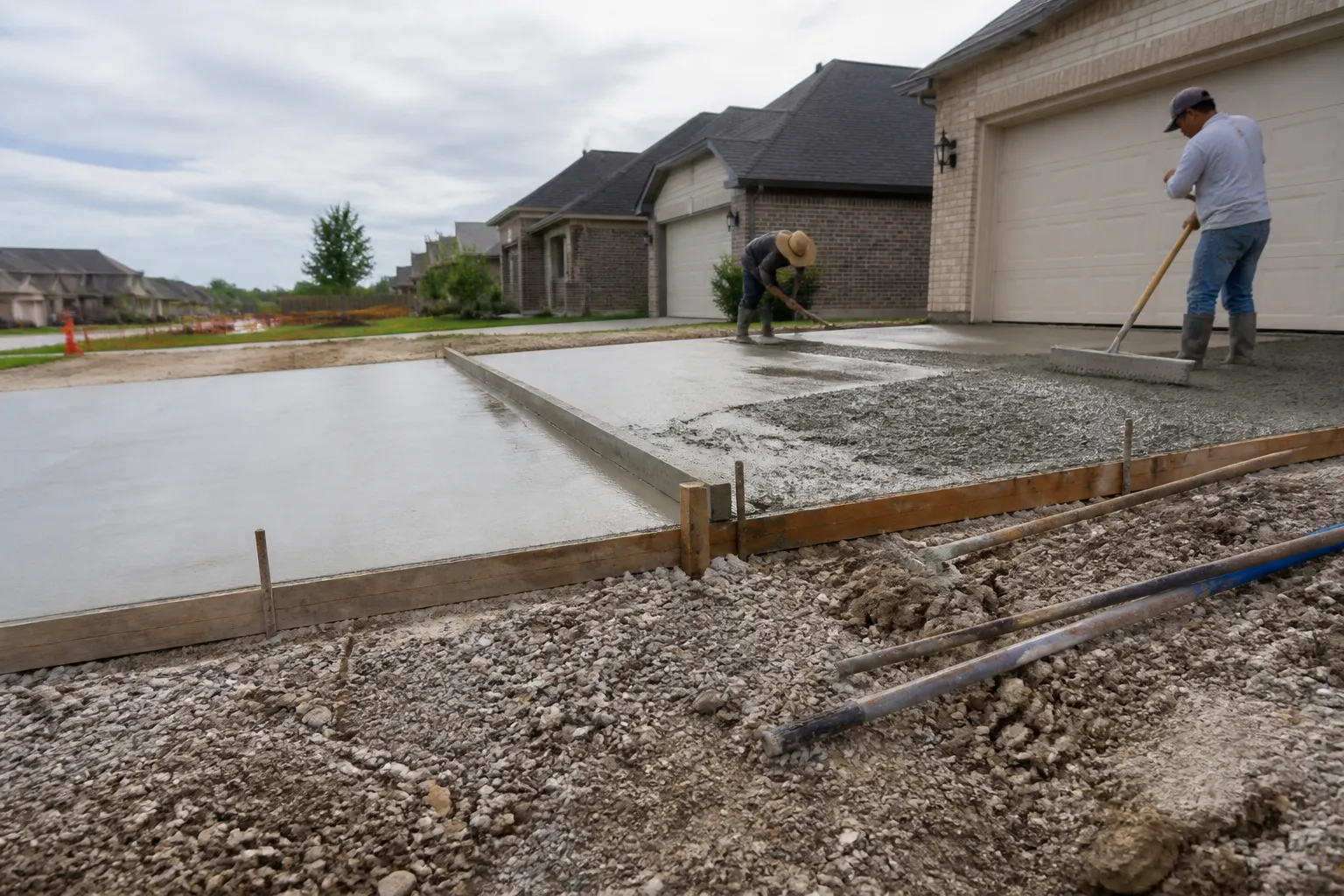
Katy Elite Concrete Contractor has repaired enough settled, cracked and undermined slabs around Katy to say this plainly: the great majority of concrete problems here start with water going somewhere it should not.
Katy sits on flat, poorly draining expansive clay in one of the wettest parts of Texas. Water does not soak away quickly. It sits, it saturates, and it moves soil. Any concrete work done without addressing drainage is being built on a moving target.
How water destroys concrete, three ways
1. It makes the clay swell and shrink
Concentrated water at one edge of a slab — under a downspout, along a poorly graded flowerbed — saturates that area while the rest stays drier. The wet clay swells and lifts one part of the slab, then shrinks in drought and drops it. That differential movement is what cracks and tilts slabs.
Uniform moisture is far less damaging than concentrated moisture. Evenly damp soil under a whole slab causes much less trouble than one soaked corner.
2. It washes out the base
Fast-moving water at a slab edge carries fine soil away, leaving a void underneath. The slab spans the void until it cracks or drops. This is the classic cause of a sunken driveway apron or a walkway section that suddenly sits low.
3. It sits on the surface
Standing water on concrete encourages algae, accelerates surface deterioration, and in decorative work causes staining and efflorescence — the white mineral bloom that appears as water moves through concrete and evaporates.
Getting the grading right
The baseline rules:
- The ground should fall away from the house — a common guideline is about six inches of drop over the first ten feet.
- Flat concrete is never truly flat. Patios, driveways and walkways should be sloped, commonly around a quarter inch per foot, so water runs off rather than pooling.
- Water should be directed to somewhere it can go — a swale, a drain, a street — not simply pushed to the neighbour’s side.
- Flower beds and mulch should not be built up against the slab or the foundation, where they hold moisture.
Before any new patio or driveway goes in, the grading is the first thing to settle. It is far cheaper to fix while the ground is open.
Gutters and downspouts
This is the cheapest high-impact fix available and the one most often neglected. A roof sheds an enormous volume of water in a Katy thunderstorm, and a downspout emptying at the edge of a slab concentrates all of it in one spot.
Extend downspouts at least five to six feet from the foundation and from any slab edge, further where the ground is flat. Buried solid pipe to a pop-up emitter in the lawn is tidier than surface extensions and does not get moved by the mower.
Drainage systems worth knowing
French drain
A gravel-filled trench with a perforated pipe, collecting water from a soggy area and carrying it somewhere useful. The standard answer for a yard that holds water.
Channel or trench drain
A linear grated drain set into the concrete, used across a driveway where it meets the garage, or along a patio edge. It intercepts sheet flow before it reaches somewhere you do not want it.
Area drains
Catch basins at low points, piped to an outfall. Useful in enclosed courtyards and low patio corners.
Permeable options
Gravel strips, planted swales or a permeable border beside a slab give water somewhere to go rather than concentrating it at one edge.
The trap: adding concrete without adding drainage
Every new slab is an impermeable surface. Water that used to soak into that footprint now runs off it and concentrates somewhere else, often at the slab edge or against the house.
A new patio without a drainage plan frequently creates a wet spot that did not exist before, and that wet spot then goes to work on the slab you just paid for. If someone quotes a large patio or driveway without asking where the water will go, that is worth pressing on.
Signs your drainage is already a problem
- Water standing on a slab or beside it more than a day after rain.
- Soil eroded away at a slab edge, or a visible gap under an edge.
- A slab section that has dropped relative to its neighbour.
- Mud splash marks on siding or brick near the ground.
- Mildew or algae on shaded concrete that keeps coming back.
- Mulch or soil washed out of beds after every storm.
Where a slab has already dropped, lifting it is usually cheaper than replacing it — see concrete leveling — but the drainage has to be corrected at the same time or it will settle again.
Frequently asked questions
Will a French drain stop my slab from moving?
It stops water concentrating in one place, which is the usual cause of differential movement. It does not stop seasonal clay movement across the whole yard.
Should I water my foundation during drought?
Many Texas foundation specialists recommend consistent, moderate watering around the perimeter in drought to keep the clay from shrinking unevenly. Consistency matters more than volume.
Can drainage be added after concrete is poured?
Yes. French drains, downspout extensions and regrading can all be done afterwards. A channel drain across an existing driveway means cutting the slab, which is more involved.
Does my patio need a slope even if it looks level?
It needs a slope. A level patio in Katy holds water.
Sort the water out first
We look at where water goes before quoting concrete, because the drainage decides how long the concrete lasts. Call (281) 201-9322.