Katy Elite Concrete Contractor installs all three of the main decorative concrete finishes around Katy, and homeowners often arrive using the terms interchangeably. They are not the same thing, and the right one depends as much on where the surface is as on how you want it to look.
Stamped concrete
Fresh concrete is coloured, then textured mats are pressed into it while it is still plastic, leaving a pattern that imitates flagstone, slate, brick or wood plank.
Strengths
The biggest visual transformation available. It genuinely reads as stone from a few feet away, at well under the cost of real stone with none of the joints to weed.
Weaknesses
It is the most technique-dependent finish there is. Stamping has to happen in a narrow window when the concrete is exactly the right stiffness — too early and the pattern closes, too late and it will not take. In Katy heat that window is short, which is why stamped work benefits from a cool-season pour.
It also needs resealing every two to three years, the sealer can become slippery when wet, and a repair is very hard to blend invisibly.
Best for
Patios and front entries where appearance leads. See stamped concrete.
Stained concrete
Colour applied to concrete that has already cured. Two types:
Acid stain reacts chemically with the concrete, producing variegated, translucent, mottled colour that looks like aged stone. Limited palette — earth tones, rust, soft greens. Permanent, because it is a chemical change rather than a coating.
Water-based stain offers a much wider colour range and more uniform results. It sits more on the surface, so preparation and sealing matter more.
Strengths
The only decorative option that works on existing concrete without any structural change. It adds no height, so it never creates a step or a door clearance problem. Often combined with saw-cut lines to suggest tile or stone.
Weaknesses
Whatever the slab looks like, you will still see it. Cracks, patches and discolouration all show through, and acid stain in particular emphasises them. Colour is unpredictable — the same stain on two slabs gives two results.
Best for
Existing patios and interior slabs in good condition. See decorative concrete.
Exposed aggregate
A surface retarder is applied to fresh concrete, then the top layer of cement paste is washed away the next day, revealing the stone in the mix.
Strengths
The most slip-resistant of the three by a clear margin, which matters around pools and on sloped driveways. Extremely durable, because the wearing surface is stone rather than cement paste. Hides dirt, oil and staining better than anything else. Low maintenance.
Weaknesses
Rougher underfoot — not ideal where people walk barefoot for long, though a smaller aggregate softens this. The look depends entirely on the stone in the mix, so ask to see the actual aggregate. Harder to clean with a broom.
Best for
Driveways, walkways, and pool deck perimeters where grip matters.
Cost, in relative terms
Plain broom finish is the baseline. Exposed aggregate is a modest step up. Staining an existing slab sits in the middle and varies with how much preparation the slab needs. Stamped is the most expensive, because it is labour-intensive and needs a larger skilled crew working fast.
Katy-specific considerations
Heat underfoot
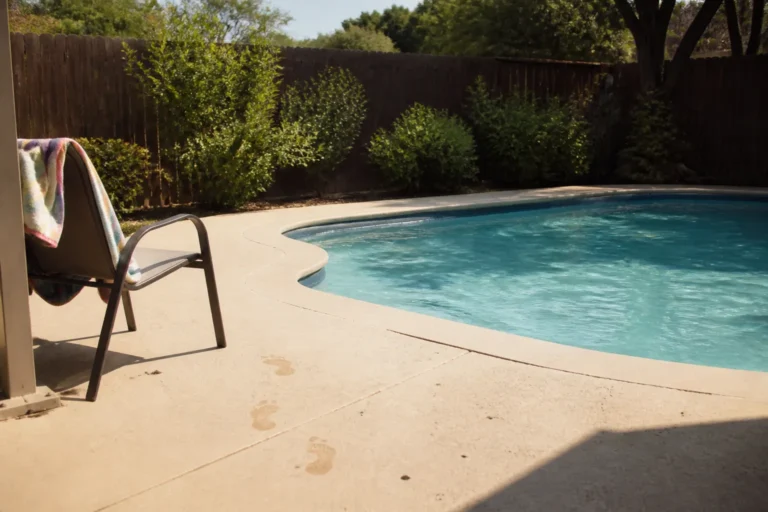
Dark colours get genuinely hot. On a pool deck or any barefoot surface, lighter colours are not a style preference but a comfort requirement. Exposed aggregate in a light stone stays coolest.
Slip when wet
Sealed stamped concrete is slick when wet unless a grit additive is mixed into the sealer. Ask for it on any stamped surface near a pool or on a slope.
Humidity and mildew
Shaded decorative surfaces grow algae in Gulf Coast humidity. All three need occasional cleaning; sealed surfaces clean more easily.
Movement
The clay soil underneath does not care how pretty the surface is. Every decorative finish still needs proper thickness, reinforcement, control joints and drainage. A beautiful surface on a badly built slab is money spent twice.
A practical middle path
Combining finishes usually gives the best value: a broom or exposed-aggregate main field with a stamped or stained border. It costs far less than full stamping and reads as a designed surface rather than a plain one.
Frequently asked questions
How long does stamped concrete last?
The concrete lasts decades. The colour and sealer need renewing every two to three years to keep looking new.
Can I stamp an existing patio?
Not directly, but a stampable overlay can be applied over a sound slab. It is thinner and less durable than integral stamping.
Does decorative concrete crack more?
No more than plain concrete. Cracks are simply more visible against a pattern or colour.
Which is best around a pool?
Exposed aggregate or a textured broom finish in a light colour. Stamped is fine with a grit additive in the sealer.
See samples in daylight
Colour on a sample board and colour on a patio in Texas sun are different things. Call (281) 201-9322 and we will show you finished work nearby.